
TailMate
A consumer product for pet owners who want to find compatible mates for their pets - designed as a small ecosystem of trust, structured discovery and responsible care, not just a swipe app dressed up in paw icons.
- Role
- Product Designer · UX Designer · Prototype Builder
- Timeline
- Concept Project
- Team
- Solo
- Category
- Pet Care Platform
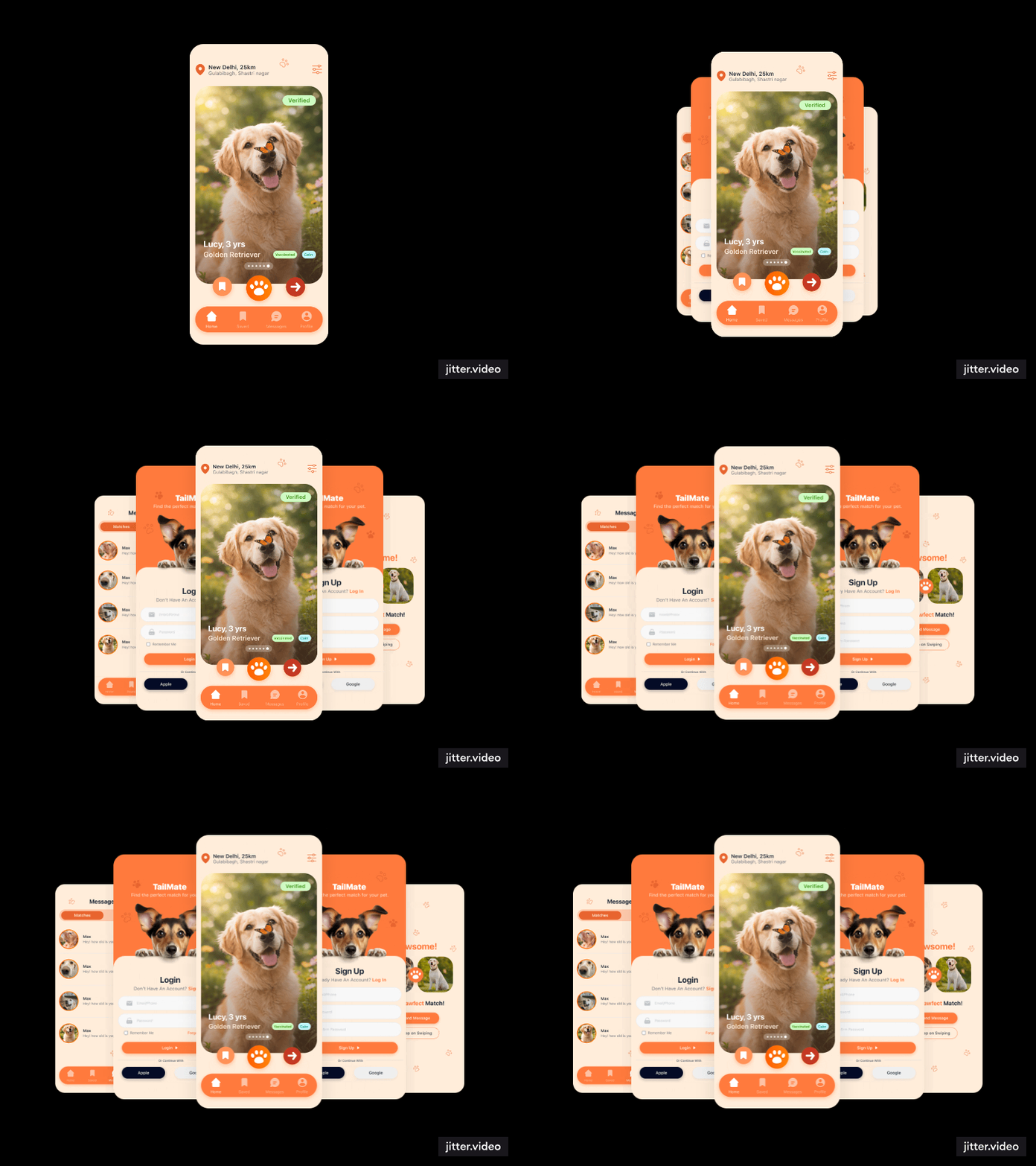
- What it is
- A consumer mobile product that helps pet owners discover compatible, verified mates for their pets.
- Who it's for
- Pet owners - mostly dog and cat parents - currently searching through social media groups, breeders, and word-of-mouth.
- Core loop
- Verify → Discover → Match → Coordinate → Care
- Built with
- Product thinking + service design + AI-assisted prototype.
The problem this product set out to solve.
What people faced
Pet owners who want to mate their pets are routed through Facebook groups, WhatsApp forwards, breeder networks and outdated listing sites. Profiles are inconsistent, health is opaque, owners are anonymous, and the entire process happens in DMs. The user spends weeks searching, verifying and coordinating manually - for a decision that affects a living animal.
The landscape
Consumer apps have solved discovery for dating, housing, jobs and travel. Pet care is one of the last consumer categories where high-stakes decisions still happen in unstructured channels. Adjacent products (Rover, Pawsh, BarkBuddy) cover walking, grooming and adoption - none of them treat mating as a first-class consumer experience.
Why it matters
The opportunity isn't another listing site. It's a small ecosystem - profiles, verification, health records, owner-to-owner coordination - designed around the actual responsibility of mating a pet, with trust and welfare built into the defaults.
The principles that guided every decision.
Trust Through Structure
Trust isn't a badge - it's the architecture. Verified owners, structured health records and clear gating shape every surface before any visual polish.
Calm Consumer Tone
No streaks, no shame, no swipe-app theatrics. Language and motion stay calm so users can think clearly about a high-stakes decision.
Structure Over Free Text
The hardest design work was deciding which fields became objects. Structured data - not paragraphs - is what lets discovery, chat, and care lean on each other.
Ecosystem, Not Single Screen
Discover, match, chat, share records and welfare are designed as one connected system. Each surface inherits trust from the ones around it.
The calls that shaped the product.
Four product calls shaped TailMate more than any visual choice. Each one started from a specific failure mode in how this currently happens - Facebook groups, breeder DMs, listing sites - and each one cost something in return.
Verification on the surface, not in a settings tab
On every adjacent platform, trust signals are buried - a badge inside the profile, a tooltip on a tab. By the time the user sees them, they've already formed an impression from the photo alone.
Promote verified owner, vet verified and vaccination current to the discover card itself, then repeat them on the profile, the match screen and the chat header. The user is never asked to remember whether this profile was safe.
Trust compounds when it's visible everywhere. A single hidden badge does the same work as no badge at all.
Health as a first-class object, not a profile field
Most listings stuff health into a paragraph: 'fully vaccinated, vet certified, healthy.' Owners can't act on that - they can't verify it, share it, or update it without rewriting the bio.
Health is its own surface, with structured fields (vaccinations with dates, vet verification with clinic, breed authenticity with registry). It exports into chat as a single attachment so two owners can share records in one tap.
Once health is an object, it can be verified, shared, expired, and updated independently. The platform can reason about it; the owner can act on it.
Intent at onboarding - mate vs. socialise
Treating every pet profile as a potential mate normalises breeding for households who never intended it, and pollutes the matching pool for those who did.
Onboarding asks the owner what they're here for - 'find a mate' or 'just socialise' - and the matching engine respects it. Socialise profiles never appear in the mating discover stream, and vice versa.
Intent is the cleanest welfare signal the product has. Capturing it once at onboarding does more to encourage responsible use than any policy page.
Keep coordination in-product until trust is established
In Facebook groups, the conversation moves to DMs within minutes - losing safety signals, context, and any record of what was promised. The platform loses the ability to protect either party.
Chat is designed to hold the conversation long enough to do the things that matter: share vet records as structured attachments, surface a safety banner with public-meeting guidance, keep verification visible in the header. Owners can leave the platform - the product just delays it until the important steps are done.
Most of the welfare and trust work happens in the first few messages. Holding the conversation through that window is the highest-leverage thing chat can do.
The primary screens and the thinking behind them.
TailMate's loop is short on purpose. Five moments carry the user from a fresh install to a real, accountable conversation with another owner.
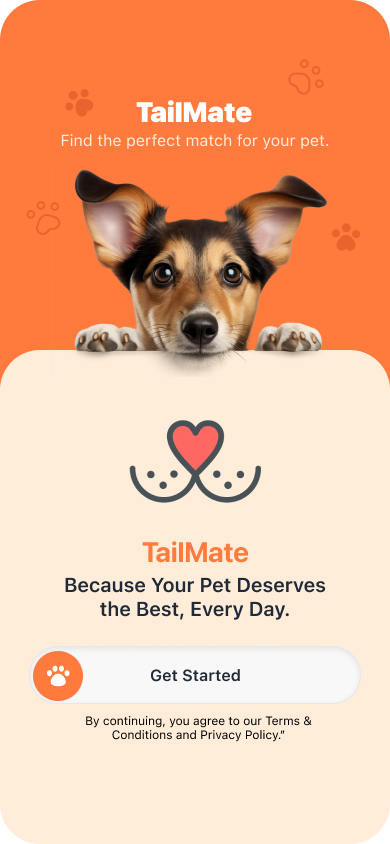
Onboard with intent
The owner adds a pet, picks species and breed, and chooses what they're here for - find a mate, or just socialise. Intent is captured once and respected by the matching engine across the product.
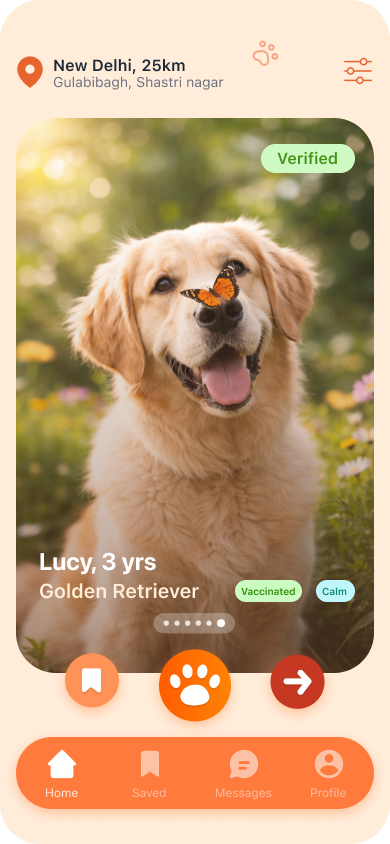
Discover with structure
The discover stream shows verified, compatible pets nearby - with location, breed and health visible without a tap. The owner skips, saves, or sends a Paw.
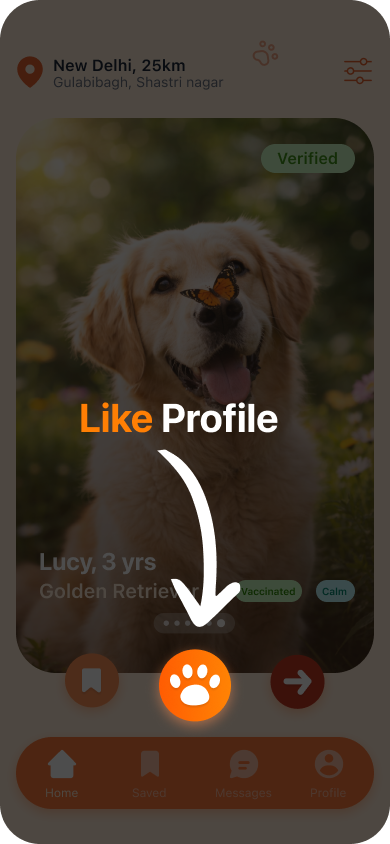
Evaluate with intent
Three deliberate actions on the discover card - save, like, skip - each with its own affordance. Owners learn the model in the first session and the platform can reason about each gesture separately.
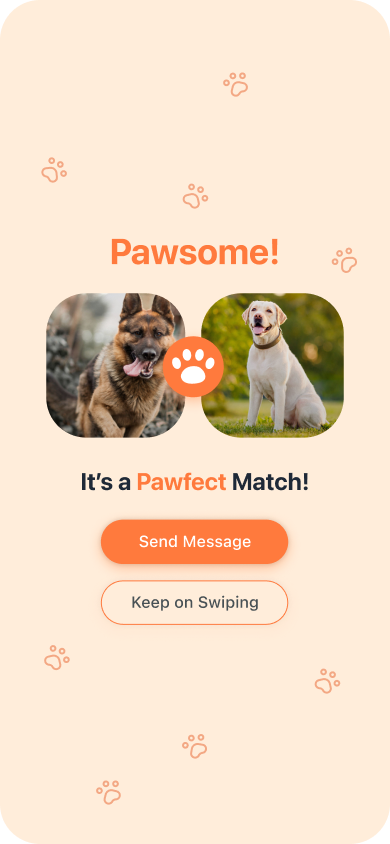
Match with scaffolding
When two owners Paw each other, the match screen surfaces both pets and a calm safety-tips pill before routing into chat. The next step is obvious; the responsibility is named.
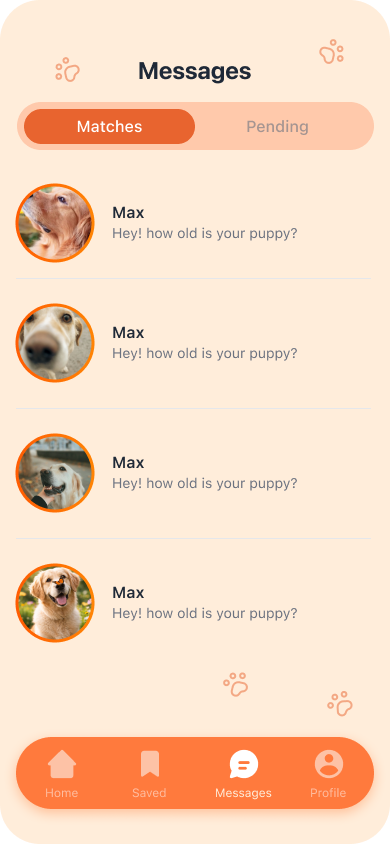
Coordinate with trust
Inside chat, verification stays visible, vet records share as structured attachments, and the conversation has the room to do the real work - agreeing on health, intent and a public meeting point.
The vocabulary behind every screen.
The visual system is warm, consumer and friendly - closer to a wellness brand than a marketplace. A cream canvas, a confident coral accent for action, sage green for trust and health, generous rounding, and language that reads more like a calm caretaker than a breeder forum.
Palette & semantics
Scale & voice
Reusable building blocks
Discover Card
Photo-led card with location, breed and health badges visible without a tap. Three actions: skip, save, Paw.
Trust Stack
A repeatable cluster of verified-owner, vet-verified and vaccination badges that appears on every surface where it matters.
Health Card
Structured vaccinations, vet verification and breed authenticity in one shareable object.
Safety Banner
Calm in-chat banner that surfaces public-meeting and record-sharing guidance without breaking the conversation.
Paw Action
The single positive interaction across the product - Paw to express interest, no public reject, never punitive.
Designed to include
- High-contrast type against a warm cream canvas; coral and sage tested for color-blindness safety.
- Trust signals carried by icon, label and position - never colour alone.
- All interactive targets ≥ 44pt; bottom-anchored primary actions on every key surface.
- Friendly tone calibrated to be welcoming for first-time pet owners, not jargon-heavy for breeders.
- Dynamic Type and reduced motion respected end-to-end.
AI-assisted development, prototyping, and validation.
I'm a designer, not a software engineer. TailMate is part of a small set of concept products where I closed the loop end-to-end - taking the idea from a service map and sketches into a working prototype with AI-assisted development, so the ecosystem could be felt instead of just diagrammed.
What it actually took
From concept to working prototype
I started with a service map - verify, discover, match, coordinate, care - then translated each node into a screen and built the connections. AI-assisted tooling let me scaffold surfaces from design intent and iterate against the live product.
Structuring the experience
The hardest design work was deciding what to structure: which fields became objects, which signals lived on which surface, what chat owned versus what the profile owned. Building made those decisions concrete; they couldn't hide in a deck.
Translating ideas into working interactions
Swipe, Paw, match, share-records, safety-prompt - every interaction had to feel calm and consumer, not gamified. Holding the prototype made those tones easy to test and easy to fix.
AI as a design pair
I directed AI to write the code; my job stayed product design, copy, information architecture and tone. The build cycle became a conversation about the ecosystem, not about syntax.
Closing the gap
Building TailMate didn't make me an engineer. It removed translation loss between intent and implementation, and let me design a product I could actually walk through end-to-end.
“A consumer trust product can't be evaluated from a deck. AI-assisted building let me hold the whole ecosystem in my hand and feel where it earned trust - and where it lost it.”
What this work achieved.
As a concept project, success is measured by the strength of the ecosystem thinking - not shipped metrics. The intended outcome is a clearer pattern for how consumer pet products can lead with trust, structure and welfare instead of treating high-stakes decisions like classifieds.
What I took away
- Trust is structural - it has to be designed into every surface, not added as a badge.
- Information architecture matters more than visual design in consumer trust products.
- Capturing intent at onboarding does more for responsible use than any policy.
- Chat is where most pet-platform trust is lost; designing it carefully recovers most of it.
What worked and what I'd improve.
- - Treating health as a structured object instead of a paragraph unlocked the rest of the product.
- - Trust signals on the discover card made the swipe feel responsible without slowing it down.
- - Capturing intent at onboarding did more for safe use than any policy ever could.
- - Post-meet follow-up flows so the product learns whether matches were actually positive.
- - Long-arc welfare signals - breeding cadence, litter outcomes - across the full lifecycle.
- - Real-world testing with vets, breed clubs and first-time owners to pressure-test the trust system.
Where this could go next.
- Care services - walking, grooming, vet booking - built on the same verified-owner spine.
- Adoption and shelter mode - extending the trust system to responsible adoption and stray support.
- Educational layer - calm, evidence-led content on health, breeding cadence and welfare.
- Post-meet follow-up flows so the product learns whether matches were positive, useful and ethical.
- Breeding cadence and welfare signals that gently discourage overbreeding at the platform level.
- Real-world testing with vets, breed clubs and first-time pet owners to pressure-test the trust system.
TailMate starts as a focused mating product, but the long arc is a small consumer ecosystem for responsible pet ownership - verified profiles and structured health as the spine, with discovery, coordination, care and learning layered on top.